
Sequential channel allocation for groups
FIFO! First in - first out
FIFO! First in - first out - channels are allocated to groups in sequence (1, 2, 3, 4 …. 157, 158, 159, 160). As adjacent channels do not have adjacent assigned frequencies, this method guarantees safe separation of the frequencies used by the channels, thus minimizing the probability of interference.
We propose dividing the pool of 160 channels into, for example, 2 groups:
- 1-80 - for groups that made reservations earlier
- 81-160 - for other groups
What to do in case of interference?
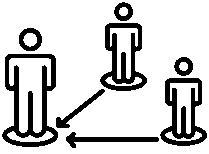
The application of the aforementioned sequential method for channel allocation minimizes the risk of interference with other transmitters. Should interference occur, the system will automatically mute the signal in the receivers. To counteract this, the group should immediately move as close as possible to the guide, as significant dispersion of visitors increases susceptibility to interference.
[vc_row full_width=”stretch_row_content” css=”.vc_custom_1759144708425{border-bottom-width: 1px !important;background-color: #F9F9F9 !important;border-bottom-style: solid !important;border-color: #E6E6E6 !important;}”][vc_column width=”1/4″ offset=”vc_hidden-xs”][vc_single_image image=”66827″ img_size=”” onclick=”custom_link” css=”.vc_custom_1759144691635{padding-top: 5px !important;padding-left: 70px !important;}” link=”http://mexpo.eu/pmab”][/vc_column][vc_column width=”3/4″ offset=”vc_hidden-xs”][/vc_column][vc_column offset=”vc_hidden-lg vc_hidden-md vc_hidden-sm”][vc_single_image image=”66827″ img_size=”” alignment=”center” onclick=”custom_link” css=”” link=”http://mexpo.eu/pmab”][/vc_column][/vc_row][vc_section][vc_row full_width=”stretch_row” css=”.vc_custom_1759144854567{background-color: #F9F9F9 !important;border-color: #FFFFFF00 !important;}”][vc_column offset=”vc_hidden-xs”][vc_custom_heading text=”Sequential channel allocation for groups” font_container=”tag:h2|font_size:50|text_align:center” google_fonts=”font_family:Noto%20Sans%3Aregular%2Citalic%2C700%2C700italic|font_style:700%20bold%20regular%3A700%3Anormal” css=”.vc_custom_1759144742866{padding-top: 50px !important;padding-bottom: 50px !important;}”][/vc_column][vc_column offset=”vc_hidden-lg vc_hidden-md vc_hidden-sm”][vc_custom_heading text=”Sequential channel allocation for groups” font_container=”tag:h2|font_size:30|text_align:center” google_fonts=”font_family:Noto%20Sans%3Aregular%2Citalic%2C700%2C700italic|font_style:700%20bold%20regular%3A700%3Anormal” css=”.vc_custom_1759144724226{padding-bottom: 20px !important;}”][/vc_column][/vc_row][vc_row full_width=”stretch_row” content_placement=”middle”][vc_column][vc_custom_heading text=”FIFO! First in – first out” font_container=”tag:h2|font_size:25|text_align:left” google_fonts=”font_family:Noto%20Sans%3Aregular%2Citalic%2C700%2C700italic|font_style:700%20bold%20regular%3A700%3Anormal” css=”.vc_custom_1758623573469{border-bottom-width: 1px !important;border-bottom-style: solid !important;}”][vc_column_text css=””]FIFO! First in – first out – channels are allocated to groups in sequence (1, 2, 3, 4 …. 157, 158, 159, 160). As adjacent channels do not have adjacent assigned frequencies, this method guarantees safe separation of the frequencies used by the channels, thus minimizing the probability of interference.
We propose dividing the pool of 160 channels into, for example, 2 groups:
- 1-80 – for groups that made reservations earlier
- 81-160 – for other groups
[/vc_column_text][vc_custom_heading text=”What to do in case of interference?” font_container=”tag:h2|font_size:25|text_align:left” google_fonts=”font_family:Noto%20Sans%3Aregular%2Citalic%2C700%2C700italic|font_style:700%20bold%20regular%3A700%3Anormal” css=”.vc_custom_1758623695418{border-bottom-width: 1px !important;border-bottom-style: solid !important;}”][vc_row_inner][vc_column_inner width=”1/4″][vc_single_image image=”67123″ alignment=”center” css=””][/vc_column_inner][vc_column_inner width=”3/4″][vc_column_text css=””]The application of the aforementioned sequential method for channel allocation minimizes the risk of interference with other transmitters. Should interference occur, the system will automatically mute the signal in the receivers. To counteract this, the group should immediately move as close as possible to the guide, as significant dispersion of visitors increases susceptibility to interference. [/vc_column_text][/vc_column_inner][/vc_row_inner][/vc_column][/vc_row][/vc_section]